
Nissan NV350 Urvan Standard M/T (2018) vs Toyota Hilux 2.4 E 4×2 M/T (2021)
A full spec-by-spec comparison of Nissan NV350 Urvan Standard M/T (2018) vs Toyota Hilux 2.4 E 4×2 M/T (2021) — engine, performance, dimensions, features and price, with the differences highlighted to help you decide.
| Specification |
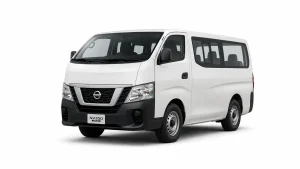 Nissan NV350 Urvan Standard M/T (2018)
Nissan
₱1,570,000
Nissan NV350 Urvan Standard M/T (2018)
Nissan
₱1,570,000
|
Toyota Hilux 2.4 E 4×2 M/T (2021) Toyota ₱1,582,000 |
|---|---|---|
| Overview | ||
| Model Year | 2018 | 2021 |
| Warranty | 3-years/ 100,000km | 3-years/100,000 km |
| Availability | Current | Current |
| Engine & Drivetrain | ||
| Engine Type | Inline-4 | Inline-4 |
| Displacement | 2488cc | 2393cc |
| Valvetrain | DOHC 16-valve | DOHC 16-valve |
| Compression Ratio | 15:1 | — |
| Aspiration | Turbocharged | Turbocharged |
| Fuel Type | Diesel | Diesel |
| Max Power | 129 PS @ 3200 rpm | 150 PS @ 3400 rpm |
| Max Torque | 356 Nm @ 1400 - 2000 rpm | 400 Nm @ 1600 - 2000 rpm |
| Transmission | 5-Speed M/T | 6-speed M/T |
| Drivetrain | RWD | RWD |
| Body & Dimensions | ||
| Body Type | Van | Pickup |
| Segment | Van | Pickup |
| Construction | Body on Frame | Body-on-frame |
| Exterior Colors | Gun Metallic, Brilliant Silver, Pearl White, Alpine White, Topaz Brown, Graphite Black | Emotional Red, Super White II, Attitude Black Mica |
| Doors | 3 | 4 |
| Seating Capacity | 15 | 2+3 |
| Length (mm) | 4695 | 5285 |
| Width (mm) | 1695 | 1855 |
| Height (mm) | 1990 | 1815 |
| Wheelbase (mm) | 2555 | 3085 |
| Curb Weight (kg) | 2076 | 2055 |
| Fuel Tank (L) | 65 | 80 |
| Chassis, Wheels & Brakes | ||
| Front Suspension | Torsion Beam | Double Wishbone w/ Coil Spring |
| Rear Suspension | Rigid Axle, Leaf Spring | Leaf Spring |
| Front Wheels | 15 steel | 17 |
| Rear Wheels | 15 steel | 17 |
| Front Tires | 195/70/R15 | 265/65/R17 |
| Rear Tires | 195/70/R15 | 265/65/R17 |
| Front Brakes | Disc | Disc |
| Rear Brakes | Drum | Drum |
| Steering Type | Hydraulic | Hydraulic |
| Steering Column | Tilt | Tilt |
| Tire Pressure Monitoring | No | No |
| Differential Lock | No | No |
| Safety | ||
| Anti-lock Braking (ABS) | Yes | Yes |
| Electronic Brakeforce Distribution | Yes | Yes |
| Brake Assist | No | No |
| Parking Sensors | No | No |
| Stability Control | No | No |
| Traction Control | No | No |
| Vehicle Dynamic Control | No | No |
| Forward Collision Mitigation | No | No |
| Blind Spot Warning | No | No |
| Hill Start Assist | No | Yes |
| Hill Descent Control | No | No |
| Auto Stop/Start | No | No |
| Driver Airbag | No | No |
| Knee Airbag | No | No |
| Passenger Airbag | No | No |
| Front Curtain Airbags | No | No |
| Rear Curtain Airbags | No | No |
| Rear Side Airbags | No | No |
| Engine Immobilizer | No | Yes |
| Security Alarm | No | Yes |
| Door Locking | Central Locking | Central Locking |
| Comfort & Convenience | ||
| Air Conditioning | Manual Aircon w/ rear independent controls | Manual Airconditioning |
| Rear A/C Vents | No | No |
| Seat Material | Fabric | Fabric |
| Parking Brake | Manual | Manual |
| Key Type | Keyless Entry | Keyless Entry |
| Push-Button Start | No | No |
| Cruise Control | No | No |
| Multi-Info Display | Yes | Yes |
| Paddle Shifters | No | No |
| Reverse Camera | No | No |
| Auto Headlights | No | No |
| Power Windows | Yes | Yes |
| Power Seats | No | No |
| Remote Trunk Release | No | No |
| Eco Mode | No | No |
| Antenna | yes | yes |
| Infotainment & Audio | ||
| Speakers | 4 | 4 |
| Touchscreen | No | Yes |
| Navigation | No | No |
| Bluetooth | No | Yes |
| Apple CarPlay | No | Yes |
| Android Auto | No | No |
| USB | No | Yes |
| AUX Input | No | No |
| AM/FM Radio | No | Yes |
| CD Player | No | No |
| DVD Player | No | No |
| MP3 Playback | No | No |
| iPod Support | No | No |
| SD Card Slot | No | No |
| Lighting | ||
| Headlights | Halogen | Halogen |
| Fog Lights | Yes | Yes |
| Daytime Running Lights | No | No |
Nissan NV350 Urvan Standard M/T (2018) vs Toyota Hilux 2.4 E 4×2 M/T (2021): which should you buy?
For a Filipino buyer deciding between the Nissan NV350 Urvan and the Toyota Hilux, the choice hinges on purpose. The NV350 (₱1,570,000) is a dedicated passenger van with a 3-door body-on-frame design and a 5-speed manual, ideal for transporting groups or as a family vehicle. Its 129 PS and 356 Nm provide adequate power for city and highway use. In contrast, the Hilux (₱1,582,000) is a 4-door pickup with a more powerful 150 PS and 400 Nm, paired with a 6-speed manual, making it better for heavy loads, off-road driving, and towing. The Hilux also offers a higher seating capacity of 5 (2+3) versus the NV350's van layout. While the NV350 is slightly cheaper, the Hilux delivers superior performance and versatility for work and adventure. For daily commuting with passengers, the NV350's enclosed cabin and lower price are advantageous. For utility, towing, or rugged terrain, the Hilux is the clear winner. Both come with a 3-year/100,000 km warranty and are currently available.
Frequently asked questions
Which vehicle is cheaper?
The Nissan NV350 Urvan is cheaper at ₱1,570,000 compared to the Toyota Hilux at ₱1,582,000, a difference of ₱12,000.
Which has more power?
The Toyota Hilux produces 150 PS @ 3400 rpm, which is higher than the Nissan NV350's 129 PS @ 3200 rpm.
Which has more torque?
The Toyota Hilux delivers 400 Nm @ 1600-2000 rpm, outperforming the Nissan NV350's 356 Nm @ 1400-2000 rpm.
Which is better for daily commuting?
For passenger comfort, the NV350 van is better suited as it provides enclosed seating for multiple people. However, the Hilux offers higher power and a 6-speed manual, which may be preferable for those needing utility alongside commuting.