
Nissan NV350 Urvan Standard M/T (2018) vs Toyota Tamaraw 2.4 Wing Van M/T (2025)
A full spec-by-spec comparison of Nissan NV350 Urvan Standard M/T (2018) vs Toyota Tamaraw 2.4 Wing Van M/T (2025) — engine, performance, dimensions, features and price, with the differences highlighted to help you decide.
| Specification |
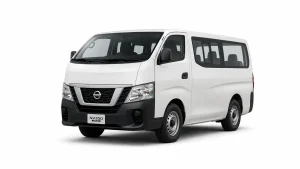 Nissan NV350 Urvan Standard M/T (2018)
Nissan
₱1,570,000
Nissan NV350 Urvan Standard M/T (2018)
Nissan
₱1,570,000
|
Toyota Tamaraw 2.4 Wing Van M/T (2025) Toyota ₱1,450,000 |
|---|---|---|
| Overview | ||
| Model Year | 2018 | 2025 |
| Warranty | 3-years/ 100,000km | 5-years/150,000km |
| Availability | Current | Current |
| Engine & Drivetrain | ||
| Engine Type | Inline-4 | Inline-4 |
| Displacement | 2488cc | 2393cc |
| Valvetrain | DOHC 16-valve | DOHC 16-Valve |
| Compression Ratio | 15:1 | — |
| Aspiration | Turbocharged | Turbocharged |
| Fuel Type | Diesel | Diesel |
| Max Power | 129 PS @ 3200 rpm | 150 PS |
| Max Torque | 356 Nm @ 1400 - 2000 rpm | 343 Nm |
| Transmission | 5-Speed M/T | Manual 5-Speed |
| Drivetrain | RWD | RWD |
| Body & Dimensions | ||
| Body Type | Van | Van |
| Segment | Van | Van |
| Construction | Body on Frame | Body-on-frame |
| Exterior Colors | Gun Metallic, Brilliant Silver, Pearl White, Alpine White, Topaz Brown, Graphite Black | Super white II, Silver metallic 1, Black |
| Doors | 3 | 2 |
| Seating Capacity | 15 | 3 |
| Length (mm) | 4695 | 5095 |
| Width (mm) | 1695 | 1830 |
| Height (mm) | 1990 | 2110 |
| Wheelbase (mm) | 2555 | 3085 |
| Curb Weight (kg) | 2076 | 1775 |
| Fuel Tank (L) | 65 | 55 |
| Chassis, Wheels & Brakes | ||
| Front Suspension | Torsion Beam | IFS Coil |
| Rear Suspension | Rigid Axle, Leaf Spring | Rigid Leaf Spring |
| Front Wheels | 15 steel | 14 |
| Rear Wheels | 15 steel | 14 |
| Front Tires | 195/70/R15 | 195R14C |
| Rear Tires | 195/70/R15 | 195R14C |
| Front Brakes | Disc | Disc |
| Rear Brakes | Drum | Drum |
| Steering Type | Hydraulic | Hydraulic |
| Steering Column | Tilt | Tilt |
| Tire Pressure Monitoring | No | No |
| Differential Lock | No | No |
| Safety | ||
| Anti-lock Braking (ABS) | Yes | No |
| Electronic Brakeforce Distribution | Yes | No |
| Brake Assist | No | No |
| Parking Sensors | No | No |
| Stability Control | No | No |
| Traction Control | No | No |
| Vehicle Dynamic Control | No | No |
| Forward Collision Mitigation | No | No |
| Blind Spot Warning | No | No |
| Hill Start Assist | No | No |
| Hill Descent Control | No | No |
| Auto Stop/Start | No | No |
| Driver Airbag | No | No |
| Knee Airbag | No | No |
| Passenger Airbag | No | No |
| Front Curtain Airbags | No | No |
| Rear Curtain Airbags | No | No |
| Rear Side Airbags | No | No |
| Engine Immobilizer | No | No |
| Security Alarm | No | No |
| Door Locking | Central Locking | — |
| Comfort & Convenience | ||
| Air Conditioning | Manual Aircon w/ rear independent controls | Manual Airconditioning |
| Rear A/C Vents | No | No |
| Seat Material | Fabric | Fabric |
| Parking Brake | Manual | Mechanical |
| Key Type | Keyless Entry | — |
| Push-Button Start | No | No |
| Cruise Control | No | No |
| Multi-Info Display | Yes | No |
| Paddle Shifters | No | No |
| Reverse Camera | No | No |
| Auto Headlights | No | No |
| Power Windows | Yes | No |
| Power Seats | No | No |
| Remote Trunk Release | No | No |
| Eco Mode | No | No |
| Antenna | yes | no |
| Infotainment & Audio | ||
| Speakers | 4 | — |
| Touchscreen | No | No |
| Navigation | No | No |
| Bluetooth | No | No |
| Apple CarPlay | No | No |
| Android Auto | No | No |
| USB | No | No |
| AUX Input | No | No |
| AM/FM Radio | No | No |
| CD Player | No | No |
| DVD Player | No | No |
| MP3 Playback | No | No |
| iPod Support | No | No |
| SD Card Slot | No | No |
| Lighting | ||
| Headlights | Halogen | Halogen |
| Fog Lights | Yes | No |
| Daytime Running Lights | No | No |
Nissan NV350 Urvan Standard M/T (2018) vs Toyota Tamaraw 2.4 Wing Van M/T (2025): which should you buy?
The 2018 Nissan NV350 Urvan Urvan Standard M/T is the better value for most Filipino buyers, priced at ₱1,570,000 versus ₱1,450,000 for the 2025 Toyota Tamaraw. Its 129 PS engine and 5-speed manual transmission suit those prioritizing budget and straightforward operation, while the 2025 model’s 150 PS output and 5-year/150,000km warranty offer stronger long-term confidence. The NV350’s 3-door configuration provides extra cargo space for families or tradespeople, whereas the Tamaraw’s 2-door design and 3-seat capacity are more suited to small households or light-duty tasks. Given the warranty gap and broader utility, the NV350 is recommended for budget-conscious users needing space, while the Tamaraw appeals to those valuing higher power and peace of mind.