
For many Filipino expats, buying a car in Qatar is less about choosing a model and more about completing the paperwork in the right order.
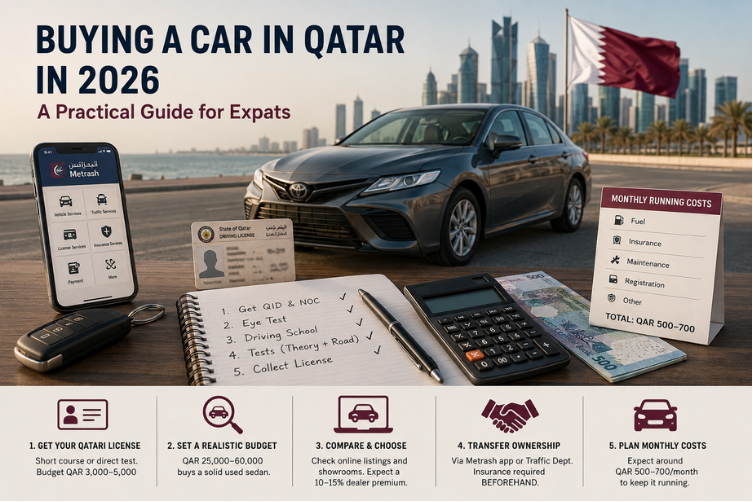
You’ll need a valid Qatari driving licence, a realistic budget, time to compare listings, valid insurance, and a vehicle that passes the required checks. A dependable second-hand sedan typically costs around QAR 25,000 to QAR 60,000, while monthly operating expenses can reach roughly QAR 500 to QAR 700 before financing or depreciation.
The biggest bottleneck is usually the driving licence. Finding and buying the car itself can often be completed within a week.
Why a car becomes essential
The Doha Metro is useful, but its coverage does not extend to every workplace or residential area. Many expats work in places such as Ras Laffan, the Industrial Area, or Al Khor, where public transport can be less convenient—especially for early-morning shifts or family errands.
Al Khor, for example, has no direct Metro station. Commuters can travel via Lusail and continue by bus, but driving is generally more practical for people who regularly travel between northern Qatar, Doha, schools, and workplaces. Al Khor is around 60 kilometers from central Doha and typically takes about 45 minutes by car, depending on traffic.
The heat is another factor. Summer temperatures can reach 45 °C, while road surfaces become significantly hotter. Regular ride-hailing can also become expensive. A family that frequently uses taxis for work, shopping, school runs, and appointments may spend around QAR 1,200 in a month.
That is why many new arrivals begin browsing cars for sale in Qatar even before they finish unpacking. Watching listings for a week or two helps establish realistic prices before you contact sellers.
It is also worth bookmarking the official websites of the Philippine Land Transportation Office and Qatar’s Hukoomi portal. Use them to check your Philippine driving licence and Qatar’s vehicle-registration requirements.
Get your licence first
You can browse, negotiate, and potentially buy a car before obtaining a Qatari driving licence. However, driving the vehicle yourself requires a licence valid in Qatar, and arranging insurance can also depend on your driving credentials.
For non-Qataris, the Ministry of Interior lists legal residency, sponsor approval, the required documents, and passing the driving test among the conditions for obtaining a licence. Applicants are referred to an approved driving school.
The profession listed on your Qatar ID may also affect your eligibility to apply. Confirm your status with the Traffic Department or an approved driving school before paying for a course.
What Filipino applicants should expect
Do not assume that a Philippine driving licence can simply be exchanged for a Qatari one. Qatar’s list of eligible exchange countries can change, so confirm the latest list with Licensing Affairs before making plans.
If your licence is not eligible for direct exchange, you may be placed in a shortened course or required to complete additional training, depending on your previous driving experience and the Traffic Department’s assessment. A foreign licence does not automatically guarantee a shortened course or an easier test.
The usual process involves:
- Obtain your Qatar ID and sponsor approval or the required No Objection Certificate.
- Complete an eye test, which commonly costs about QAR 50.
- Enrol at an approved driving school, such as Karwa Driving School, Doha Driving Academy, or Al Khebra.
- Complete the required theory and practical training.
- Pass the theory, parking, and road tests.
- Pay for and collect your Qatari driving licence.
The official MOI process requires a sponsor approval letter for an employee, along with identification documents and photographs.
Driving schools commonly advertise full-course fees of around QAR 2,800 to QAR 3,600. Packages with unlimited lessons until you pass can cost approximately QAR 6,000 to QAR 9,100. Depending on the applicant’s schedule, school availability, and test results, the entire process can take several weeks to a few months.
A practical budget is QAR 3,000 to QAR 5,000 for the licence process, although applicants who need additional lessons or retests may spend more. The licence itself is commonly issued for five years to residents and may cost around QAR 250.
Start the process as soon as your QID is available. You can use the waiting period to study the car market.
Can you drive while waiting?
Do not rely solely on advice from friends or social-media groups. Qatar’s rules for visitors, tourists, residents, foreign licences, and international driving permits may differ.
The MOI states that non-Qataris need legal residence to obtain a Qatari licence, while visitor and tourist rules may apply differently. Once you become a resident, confirm directly with the MOI or Traffic Department whether your Philippine licence or IDP remains valid for the type of driving you intend to do.
This is also important for insurance. Driving without a licence valid for that situation could affect coverage after an accident.
New or used?
New cars may look attractive because Qatar currently has no VAT or sales tax, although the government has discussed introducing VAT in the future. New private vehicles may also receive an initial registration period of up to three years, while vehicles older than three years generally require annual inspection before registration renewal.
However, depreciation can be significant. For expats on a two- or three-year contract, a lightly used vehicle with complete service records may offer better value.
| Factor | New car | Three- to six-year-old used car |
|---|---|---|
| Typical budget | QAR 50,000–95,000 | QAR 25,000–60,000 |
| First-year depreciation | Around 20%–30% | Around 8%–12% |
| Fahes inspection | Usually not required initially | Required according to vehicle age |
| Main advantage | Warranty and predictable history | Lower purchase price and depreciation |
| Main risk | Steeper initial depreciation | Hidden accident or maintenance issues |
Treat these figures as working ranges rather than fixed market prices. Actual prices vary by brand, mileage, GCC specifications, accident history, service records, and resale demand.
Where to shop
There are four common ways to buy a car in Qatar.
Online marketplaces
Online listings provide the widest selection and are useful for comparing prices. Filter by model year, mileage, trim level, and location. Track similar cars for at least a week so you can identify unrealistic asking prices.
Used-car dealerships
Showrooms along Salwa Road offer convenience, financing options, warranties, and help with paperwork. The trade-off is that dealer asking prices are often higher than comparable private listings.
Compare the same model, year, mileage, and specification across online marketplaces and dealerships before negotiating.
Private sellers
Private sellers, particularly expats preparing to leave Qatar, may offer some of the best prices. Cars are often discounted during the final weeks of an owner’s contract because the seller wants to complete the sale before departure.
However, private transactions require more careful checking. Ask immediately whether the vehicle has outstanding finance or a mortgage.
Auctions and repossessions
Bank repossessions and auctions can be cheaper, but they are also riskier. Vehicles may have limited inspection opportunities, no meaningful warranty, and no test drive.
A financed vehicle cannot normally be transferred until the lender releases the lien or approves the transaction. The transfer system also blocks vehicles with unresolved fines.
Transfer, insurance, and registration
Vehicle ownership transfer can be completed at a Traffic Department office or through the Metrash app, provided the required documents and clearances are in place.
Before the transfer, check that you have:
- The vehicle’s valid Istimara.
- The buyer’s and seller’s Qatar IDs.
- Insurance issued or transferred in the buyer’s name.
- A valid Fahes inspection, when required.
- No outstanding traffic violations or unpaid fines.
- Lender approval or mortgage release, if the car is financed.
Outstanding fines must be settled before the transfer can proceed. Expatriates generally do not need an NOC specifically for vehicle ownership transfer, although sponsor documents may still be relevant in other parts of the process.
Metrash transfer
The typical Metrash process is:
- The seller signs in to Metrash and selects the vehicle ownership-transfer service.
- The seller enters the buyer’s QID and mobile number.
- The buyer receives and approves the request in Metrash.
- The required fees are paid electronically.
- The updated Istimara is delivered or collected, depending on the selected option.
The transfer fee is commonly around QAR 200, although fees and procedures should be confirmed in the app before completing the transaction.
Fahes inspection
Fahes inspections are required for older vehicles before registration renewal. The inspection fee for cars is commonly around QAR 150, and appointments may be arranged through the WOQOD app.
A vehicle that fails may receive a free reinspection under the applicable rules. Check the current Fahes procedure before booking, as station hours and reinspection conditions can vary.
Insurance
Third-party liability insurance is the legal minimum and may cost approximately QAR 400 to QAR 700 a year, depending on the driver and vehicle.
Comprehensive insurance is commonly priced as a percentage of the vehicle’s value. A rough estimate is 2% to 4% annually. For a QAR 40,000 sedan, that could mean around QAR 800 to QAR 1,600 per year, although the final premium depends on the insurer, driver profile, vehicle age, deductible, and coverage.
Arrange insurance before visiting the Traffic Department. A valid policy in the buyer’s name is required for the transfer process.
Private light vehicles typically pay around QAR 100 for annual registration renewal, separate from inspection and insurance costs.
Monthly ownership costs
Consider a QAR 40,000 sedan driven 15,000 kilometers per year and consuming 8 liters per 100 kilometers.
Using Super 95 fuel at QAR 2.10 per liter as an example, the estimated monthly operating costs could look like this:
| Cost item | Estimated monthly cost |
|---|---|
| Fuel | QAR 210 |
| Comprehensive insurance | QAR 100 |
| Registration and Fahes | QAR 21 |
| Servicing, tires, and wear items | QAR 150 |
| Parking, washing, and contingency | QAR 50 |
| Estimated total | Around QAR 530 |
Fuel prices are updated by QatarEnergy and can change monthly, so treat QAR 2.10 as an example rather than a permanent rate.
This QAR 530 estimate excludes financing and depreciation. Depreciation can be one of the largest costs of ownership, particularly for a new vehicle, so calculate it separately when comparing cars.
Check the car before paying
Before handing over a deposit or making a full payment, confirm the following:
- The service history is available and, ideally, stamped by the workshop or dealer.
- The VIN on the chassis matches the VIN on the Istimara.
- The body panels have consistent paint, gaps, and alignment.
- There are no obvious signs of accident repairs.
- The air-conditioning remains cold while the car is idling.
- The vehicle has no outstanding fines.
- The tires, brakes, suspension, lights, and fluids are in acceptable condition.
- The car passes an inspection by an independent workshop.
An independent pre-purchase inspection may cost around QAR 200 to QAR 300. It is one of the most worthwhile expenses in the buying process, especially for older vehicles.
A low-priced car can become expensive quickly if it needs a transmission, air-conditioning system, suspension components, or major electrical repairs.
A practical buying timeline
For most Filipino expats, the most sensible sequence is:
- Start the driving-licence process as soon as your QID and sponsor documents are ready.
- Watch online listings while waiting for theory and practical-test schedules.
- Build a budget that includes insurance, inspection, registration, repairs, and emergency costs.
- Compare private sellers and dealerships using the same model-year and mileage criteria.
- Have the vehicle inspected independently before payment.
- Confirm the car has no fines, finance, or transfer restrictions.
- Arrange insurance and complete the transfer through Metrash or the Traffic Department.
Buying in your second month may be realistic if the licence process moves quickly. If you are financing the car, also confirm the lender’s residency, salary, employment, and contract requirements before committing.
Frequently asked questions
Can I drive with a Philippine licence or IDP while waiting for a Qatari licence?
There is no single rule that applies to every foreign national after receiving a QID. Visitor and tourist provisions may allow driving with a valid international licence for a limited period, but those rules do not necessarily apply once you become a resident.
Confirm your position with the MOI or Traffic Department before driving regularly. Also check with your insurer, since driving without a licence valid for that situation may affect a claim.
Do I need a Qatari licence before buying a car?
Not necessarily for browsing, negotiating, or arranging a purchase. However, the registration, insurance, and transfer requirements depend on your residency documents and the current Traffic Department process.
The safest practical approach is to begin the licence application first, continue comparing cars while you wait, and complete the purchase once your documents and insurance eligibility are clear.
Can I register the car in my name as an expat?
Vehicle ownership transfer is available to residents, subject to valid identification, insurance, a clean fines record, and any required inspection. Financed vehicles also require the lender’s approval or release of the mortgage.
Confirm the latest requirements in Metrash or with the Traffic Department before paying a deposit.
What happens to the car when my contract ends?
Plan to sell the car before leaving Qatar. Outstanding finance, unpaid fines, or unresolved ownership issues can delay the sale and may complicate departure procedures.
Allow four to six weeks if you want to sell at a fair price rather than accepting the first low offer. This is also why departing expats sometimes list vehicles below the usual market price during their final weeks.
The most practical strategy is straightforward: start the licence process immediately, study listings while you wait, and only buy after the vehicle, paperwork, insurance, and inspection all check out.





0 Comments
Leave a Reply