
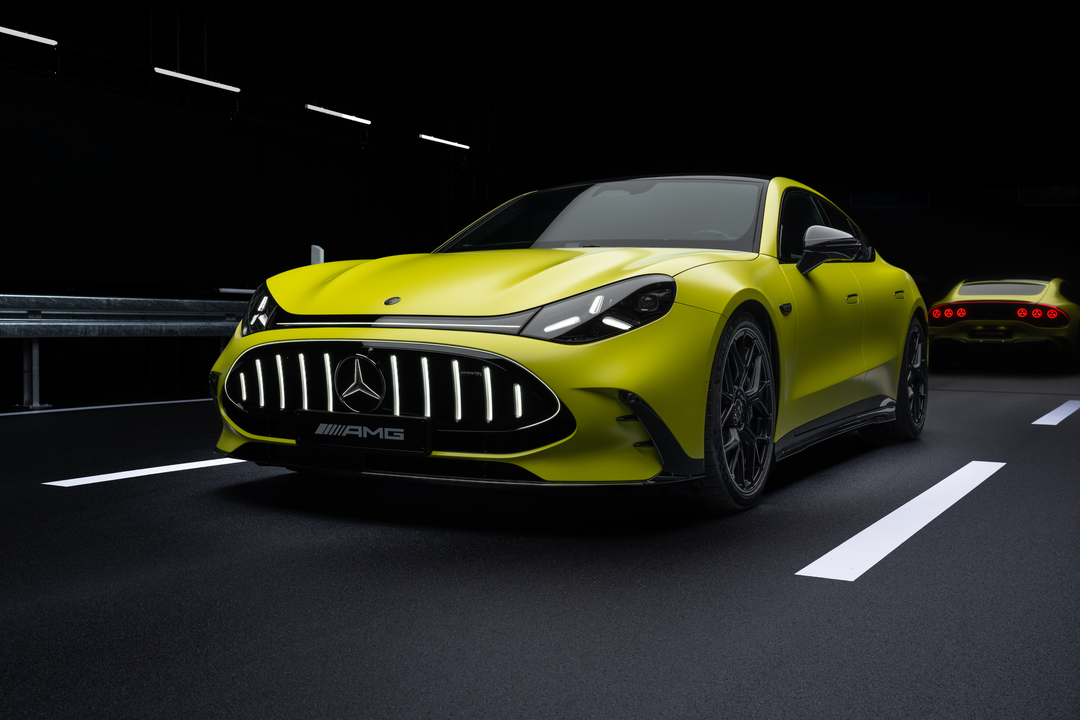
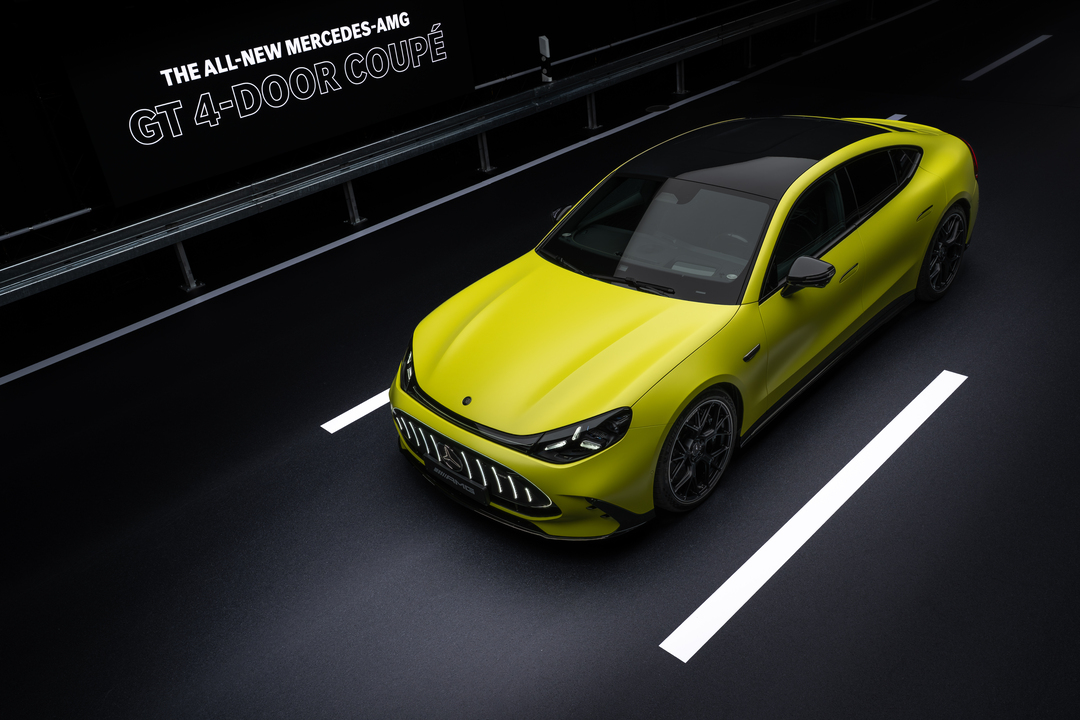
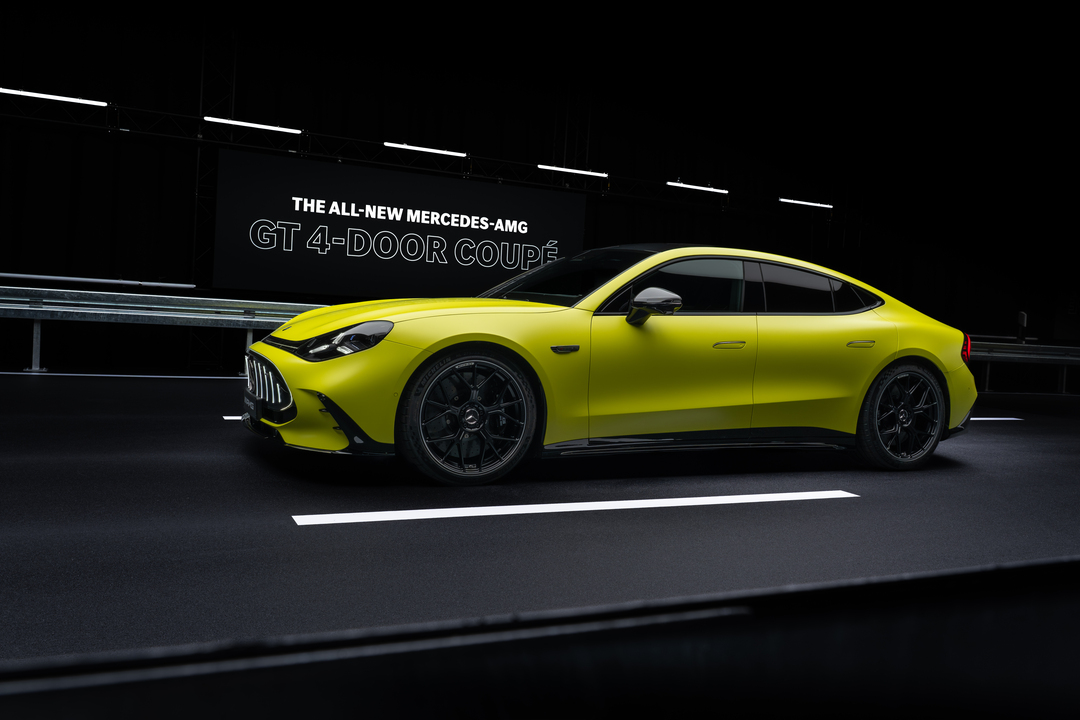
Mercedes-AMG has officially revealed the all-new, all-electric GT 4-Door Coupé, its first all-electric performance sedan built on the new AMG.EA platform, and was also showcased in the Concept AMG GT XX from less than a year ago. The car will be available in two variants, the GT 63 and GT 55, with ordering set to open in the coming days. Pricing will be aligned with comparable predecessor models. That said, there’s a lot of technology to unpack here.
The GT 4-Door Coupé is the first series-production electric vehicle to use axial-flux motors, a technology developed by YASA, a British electric-motor company that Mercedes-Benz fully acquired in July 2021. The car uses three of these motors — two at the rear axle and one at the front — housed in High-Performance Electric Drive Units (HP.EDU) at each axle.
In an axial flux motor, the electromagnetic flux runs parallel to the motor’s axis of rotation rather than perpendicular, as in conventional motors. Two rotors enclose the stator in an H-configuration, enabling more efficient magnetic coupling. The result is a more compact motor that delivers higher continuous power and torque than traditional designs. The front motor measures about 9 centimeters wide; each rear motor is roughly 8 centimeters wide.
The GT 63 4MATIC+ produces 860 kW (1,169 hp) peak output, measured during AMG Launch Control at 80% state of charge. The GT 55 4MATIC+ delivers 600 kW (816 hp). The architecture is technically designed to support outputs beyond 1,000 kW in the future.
Performance figures for the GT 63 include a 0–100 km/h sprint of 2.1 seconds, a 0–200 km/h run of 6.4 seconds, and a top speed of 300 km/h with the optional Driver’s Package.
The front motor functions as a booster, only engaging when additional power or traction is needed. A Disconnect Unit (DCU) decouples the front motor during steady-state driving to reduce drag losses, reconnecting within milliseconds during acceleration or hard braking.
The rear HP.EDU integrates two axial flux motors, a single-stage planetary gearbox, oil cooling, and two water-cooled silicon-carbide (SiC) inverters — one per motor. The front HP.EDU uses a spur-gear transmission with an integrated parking lock and a liquid-cooled SiC inverter. The rear motors spin at over 13,000 rpm at top speed; the front motor reaches over 15,000 rpm.
Mercedes-AMG developed the high-voltage battery specifically for this vehicle, drawing on knowledge from the AMG ONE hypercar and its Formula 1 work conducted through AMG High Performance Powertrains (HPP) in Brixworth, England.
The battery uses 2,660 cylindrical cells, each 105 mm tall and 26 mm in diameter. This format was chosen to shorten the distance from the cell core to the surface, improving heat dissipation. The cells feature an aluminum housing that is laser-welded and lighter than conventional steel housings, with better electrical and thermal conductivity. A full-tab design connects the cell windings across the full surface of both poles, reducing internal resistance and enabling higher charge and discharge rates.
The 2,660 cells are grouped into 18 laser-welded plastic modules. Each cell is directly cooled by an electrically non-conductive oil-based coolant flowing through channels in the modules. The cooling system achieves at least 20 kW of cooling capacity, compared to 5–8 kW in conventional battery systems.
The battery operates on an 800-volt architecture, which reduces wiring weight, increases continuous power output, and reduces charging cable losses. The battery management system (BMS) is an AMG in-house development and uses virtual sensors — mathematical models that calculate cell temperatures without physical sensors. All this makes sure that the battery architecture is designed to support WLTP ranges of over 700 km in future configurations.
The GT 4-Door Coupé supports a peak charging rate of over 600 kW, drawing more than 800 amperes at compatible infrastructure. Under these conditions, approximately 460 km of range can be recovered in 10 minutes. A 10–80% charge takes 11 minutes.
In terms of world charging standards, the car supports five charging standards: CCS2 in Europe, GB/T in China, CHAdeMO in Japan, CCS1 in South Korea, and NACS in the USA. It can also switch from 800V to 400V to support older infrastructure.
The GT 4-Door Coupé uses multi-link axles at both the front and rear. Front suspension components, not including the tie rod, are forged aluminum to reduce unsprung mass. The rear suspension uses aluminum spring links, while all other links are steel. The body-in-white is a new development using a mix of aluminum, steel, and fiber-reinforced composites.
Standard suspension is the AMG ACTIVE RIDE CONTROL air suspension with semi-active roll stabilization. It uses triple-adjustable air springs and replaces conventional anti-roll bars with hydraulically interconnected shock absorbers, adjustable in both rebound and compression. An 8.2-liter pressure reservoir enables quick ride-height changes. The system hydraulically connects the compression and rebound sides of the dampers, with a central pump and valves controlling roll stiffness.
The rear-axle steering adjusts up to 6 degrees in either direction. Below 80 km/h, the rear wheels steer in the opposite direction to the fronts to shorten the virtual wheelbase for tighter cornering. Above 80 km/h, they steer in the same direction — up to 1 degree — to improve stability. The system responds differently depending on the selected drive mode and also supports automatic and remote parking.
Torque vectoring distributes drive force between the two rear wheels. The AMG Performance 4MATIC+ system seamlessly transitions between rear-wheel and all-wheel drive based on conditions. The braking system combines a carbon-ceramic brake at the front axle with a steel brake at the rear, a configuration chosen to balance performance and weight.
Several active aerodynamic systems are fitted. Two AEROKINETICS Venturi Flow Plates in the underbody deploy automatically — the front from 120 km/h, the central from 140 km/h — to accelerate airflow beneath the car and generate downforce. An active AEROKINETICS rear diffuser deploys based on speed and driving conditions. The rear spoiler is integrated into the boot lid and deploys from 80 km/h across several angle positions; at high speed or during dynamic driving, it moves to maximum angle for downforce, and can also be activated manually via a steering wheel button.
The AEROKINETICS Airpanel system uses vertical louvers behind the front air intake and, for the first time in any Mercedes-Benz (or AMG for that matter), also provides brake-cooling intakes on both sides. These remain closed during normal driving to reduce drag, and open in 9 stages as cooling demand rises.
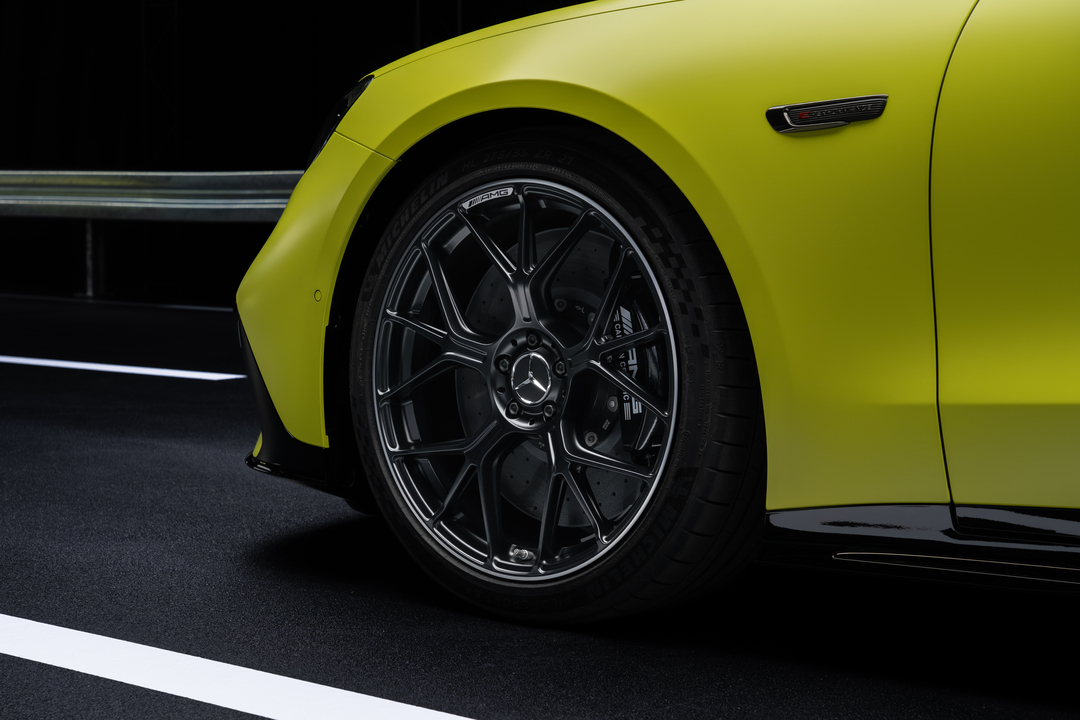
Standard air suspension also lowers the ride height in two stages based on speed to reduce drag. Wheel options run from 19 to 21 inches. Aerodynamically optimized 21-inch wheels add up to 14 km of WLTP range; aerodynamically optimized tires can add up to 30 km.
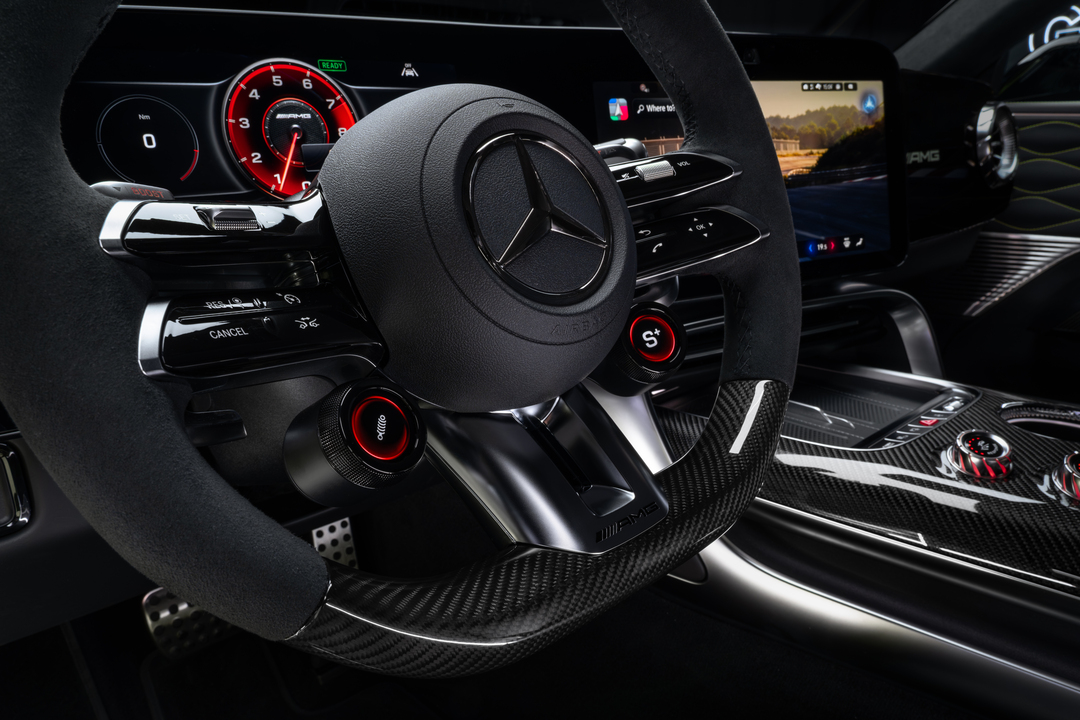
For drivers who prefer the feel and sound of a combustion engine, AMGFORCE S+ mode simulates a high-performance V8. The system uses over 1,600 sound files processed by a real-time mixing engine, generating engine sounds, simulated gearshifts, and characteristic burbling through the audio system. It also produces haptic feedback by briefly interrupting traction to mimic gear changes. The driver display switches to a central-tube layout resembling a traditional instrument cluster.
Additional sound cues include a bass tone on approach and unlock, heartbeat-style pulses on entry, confirmation sounds on locking, a click when plugging in the charging cable, and a hum during charging. The Sound Slider feature lets drivers tune cabin sound on a scale from Classic to Futuristic and from Powerful to Minimal.
The car’s driving dynamics are managed by the AMG RACE ENGINEER system, which consists of two components. The AMG RACE ENGINEER Core is a high-performance chip in the central computer that manages all drive and dynamics systems. The underlying software — covering drive control, recuperation, energy management, charging, and thermal management — was developed in-house by AMG.
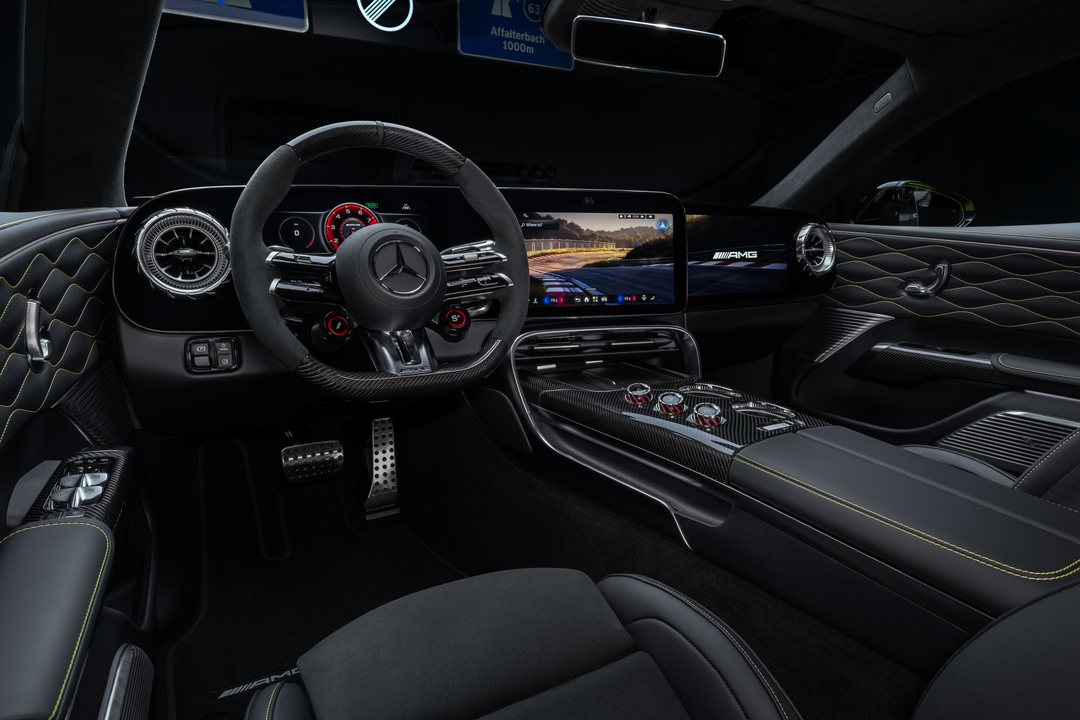
The AMG RACE ENGINEER Control Unit consists of three physical rotary controllers in the center console. The first, Response Control, adjusts how the motors respond to accelerator inputs. The second, Agility Control, adjusts cornering behavior by varying torque distribution to create the sensation of a shorter or longer wheelbase, ranging from mild understeer to controlled oversteer. The third, Traction Control, adjusts the traction control intervention level across nine stages. These controllers are active in Race, S+, and S programs with ESP off.
Seven AMG DYNAMIC SELECT programs are available: Comfort, Sport, AMGFORCE Sport+, Race, Slippery, Eco, and Individual. Comfort is the default everyday mode, with a gentle accelerator response and a normal ride height. Sport prioritizes performance with sharper throttle response, firm suspension, and a lowered ride height. AMGFORCE Sport+ activates the V8 simulation with haptic gearshifts, signature sound inside and out, and the central-tube display layout. Race is configured for track use and gives full access to RACE ENGINEER controls, AMG TRACK PACE, and sub-modes including Drift Mode, Drag Race, and Track Race. Slippery keeps the all-wheel-drive system permanently active and sets the suspension to soft for low-grip conditions. Eco runs the car in rear-wheel drive with reduced power, torque, and top speed, and lowers the ride height to maximize range. Individual allows drivers to set their own parameter combination.
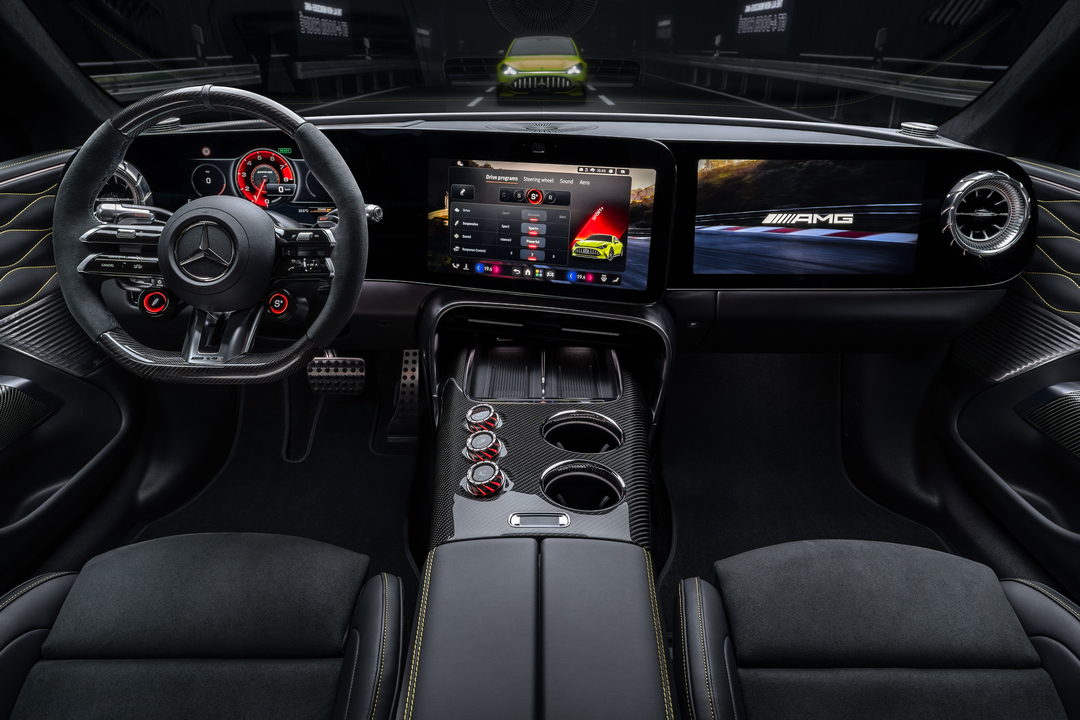
AMG Launch Control is available in S, S+, and Race modes, activated by fully depressing the brake pedal, then the accelerator, then releasing the brake. In Comfort, Sport, and Sport+ modes, pulling both steering-wheel paddles simultaneously unlocks a temporary boost — 110 kW additional on the GT 63, 50 kW on the GT 55 — with automatic seatbelt tightening and dedicated audio feedback.
The interior uses a 10.2-inch instrument cluster and a 14.0-inch multimedia monitor in a seamless-glass display unit. A separate 14.0-inch passenger display is optional. The system runs on Mercedes-Benz’s MB.OS operating system and integrates ChatGPT, Microsoft Bing, and Google Gemini through the MBUX Virtual Assistant.
Three AMG-specific apps are included. The AMG Performance Menu shows real-time data including energy flow between axles, aerodynamic element status, tire and engine temperatures, lateral acceleration, tire pressure, damper status, and battery state. AMG Set-Up lets drivers configure steering-wheel button order and manually activate aerodynamic elements at any speed. AMG Track Pace records over 80 vehicle data points at 10 Hz during track sessions, including lap and sector timing, preloaded circuits such as the Nürburgring and Spa-Francorchamps, an augmented-reality racing-line overlay on the multimedia display, and an optional dashcam with data overlay.
The Predictive Performance Manager (PPM) manages energy distribution on track in either Endurance or Hotlap mode, adjusting power output section by section around a circuit rather than delivering maximum power throughout.
Cooling
A Central Coolant Hub (CCH) manages the entire cooling system through a single integrated component housing pumps, sensors, and valves. It can independently direct cooling to specific subsystems, for example, redirecting capacity from the battery when it is within its optimal temperature range to the electric drive units. A single large cooling circuit with intelligent valves, supported by a chiller and both main and auxiliary radiators, manages overall thermal efficiency.
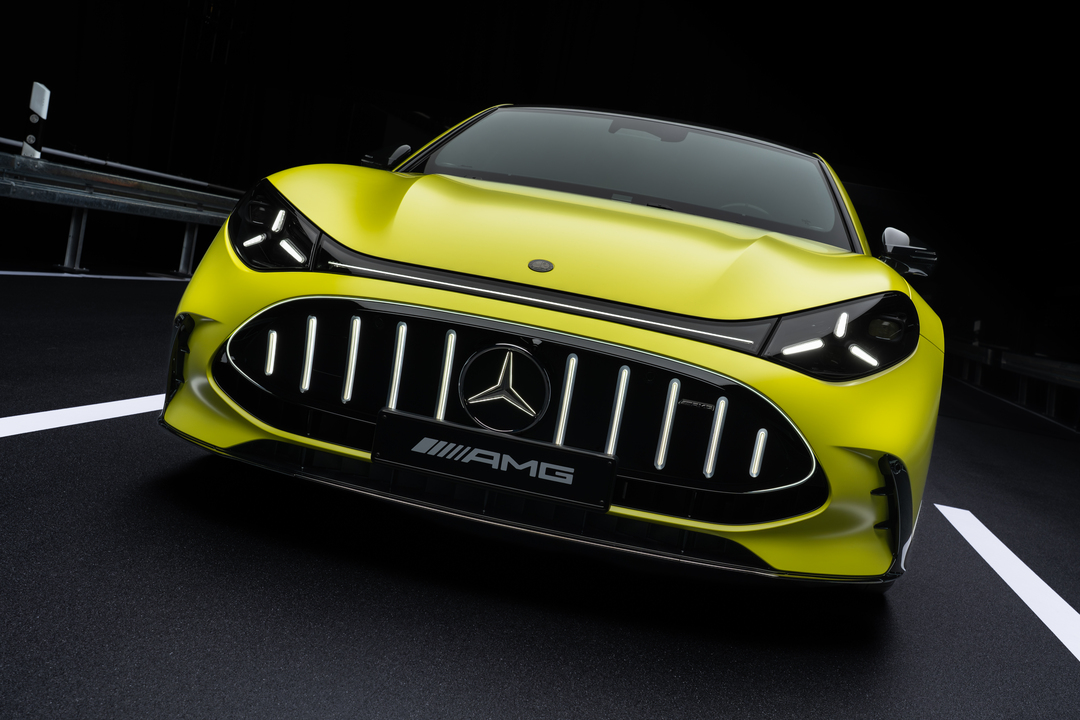
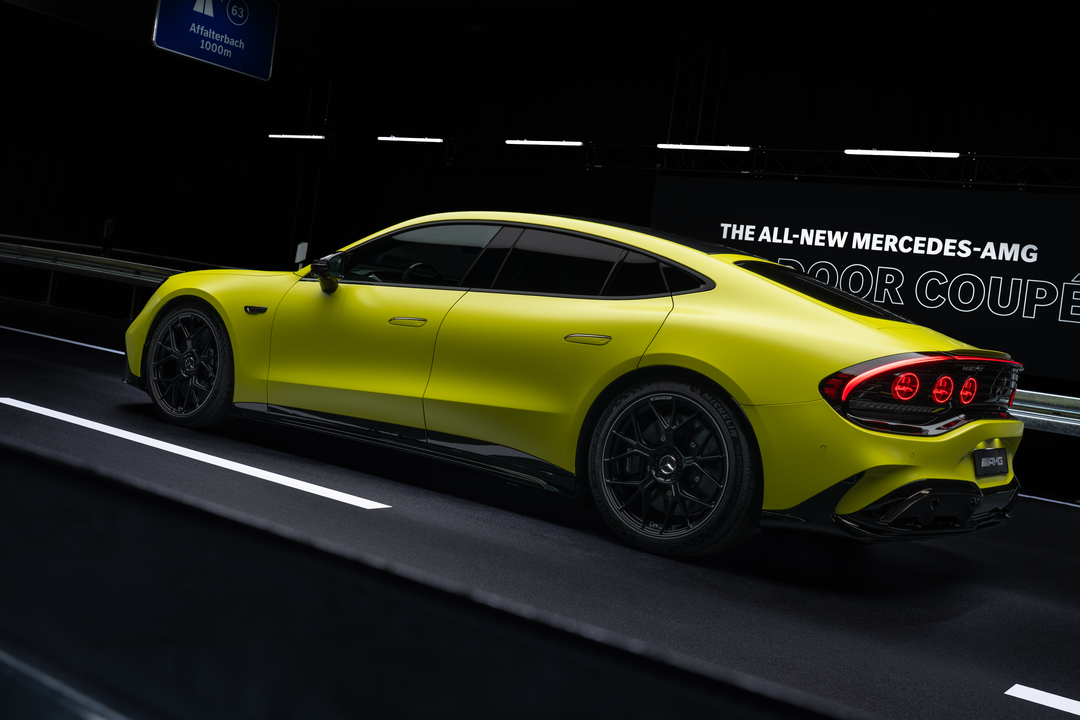
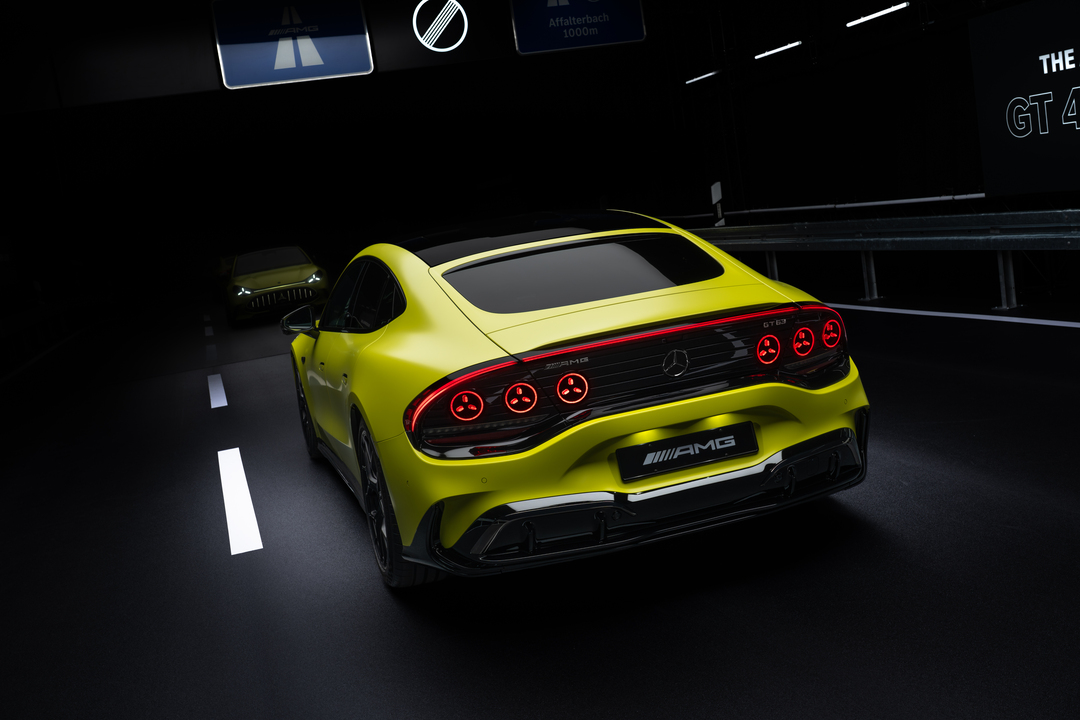
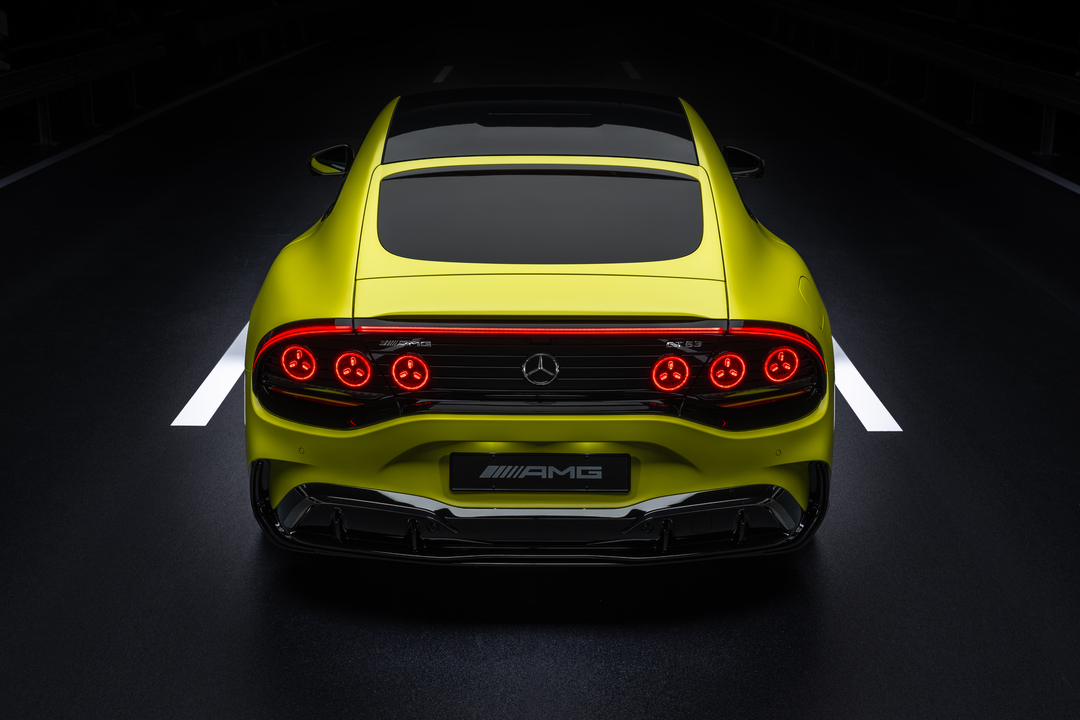
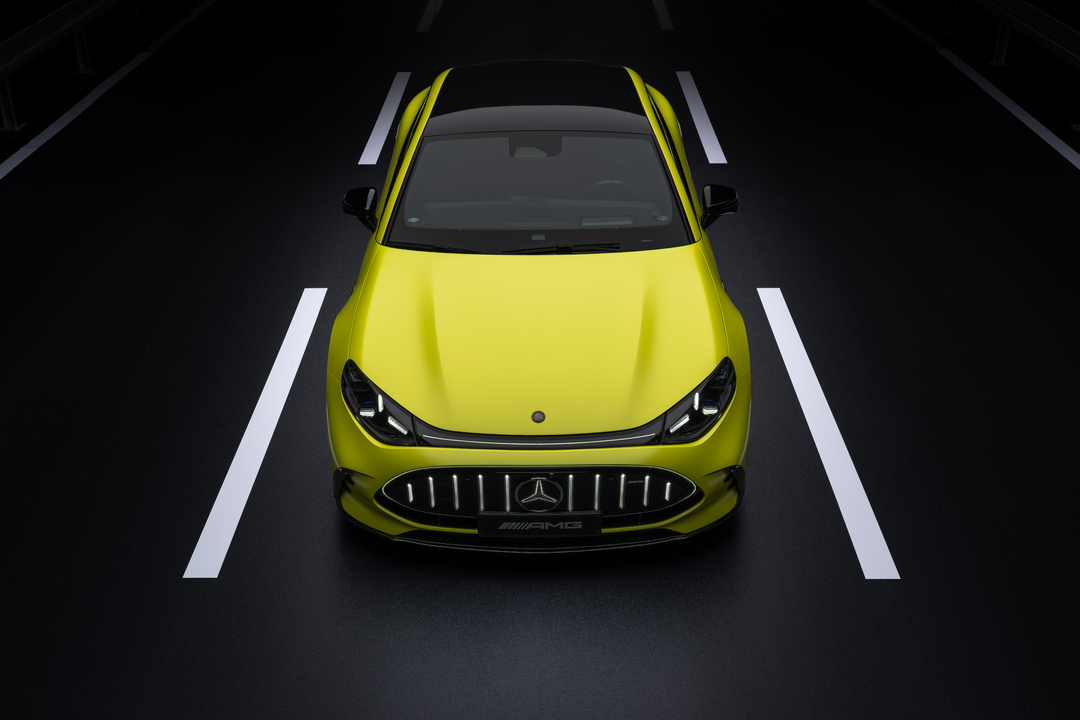
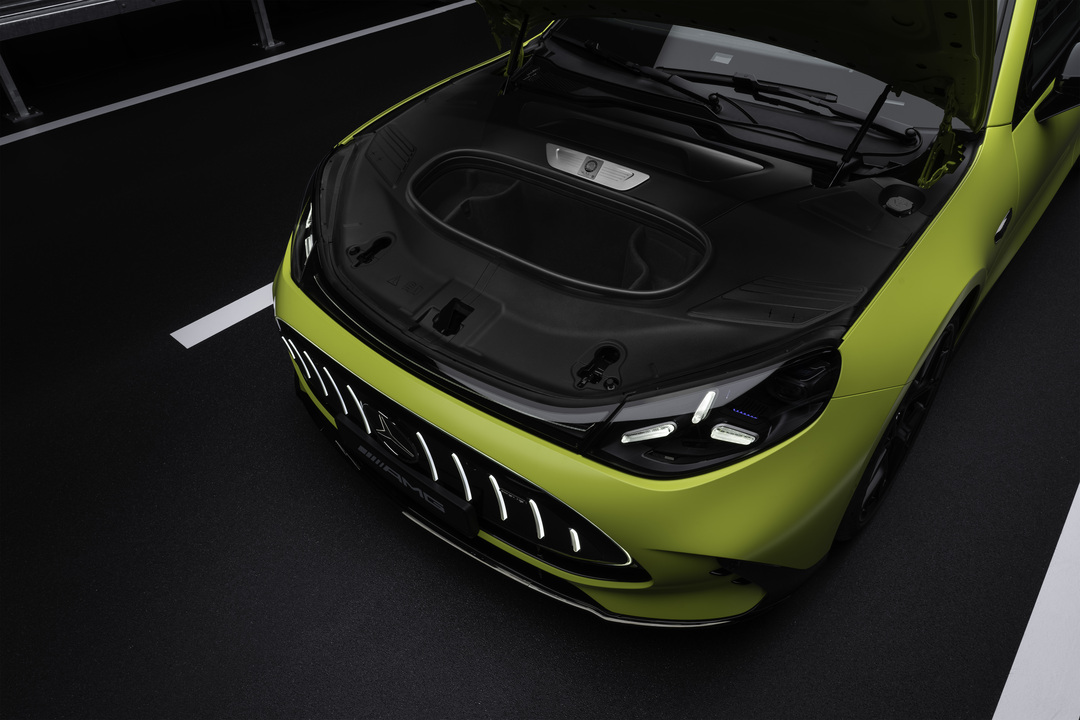
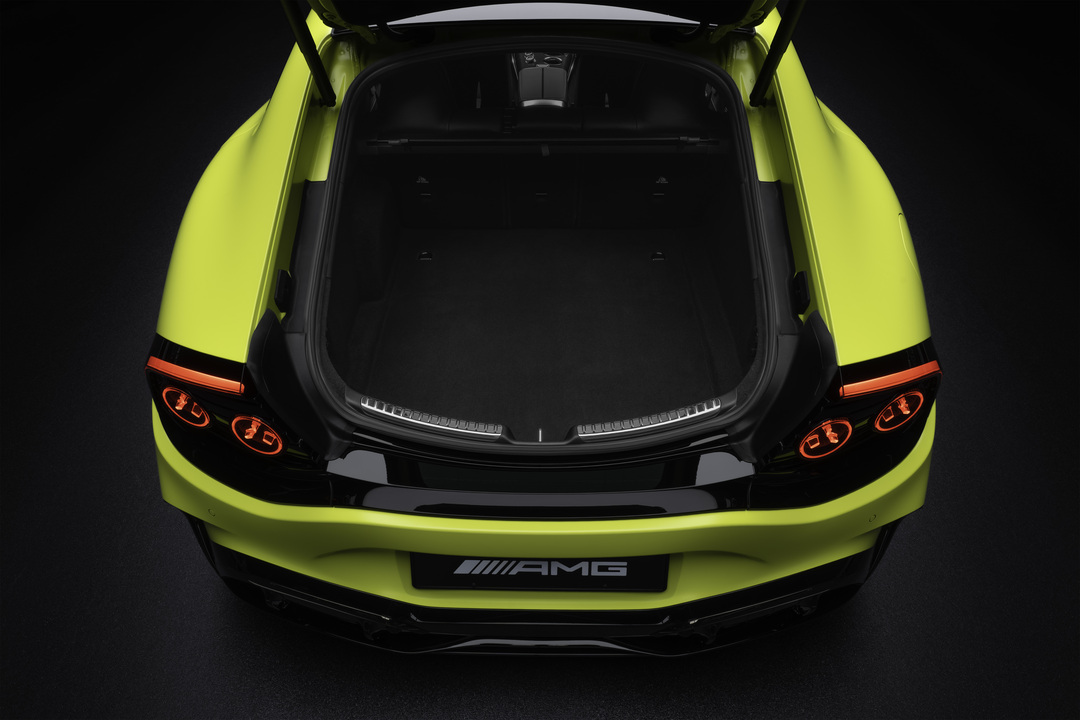
The GT 4-Door Coupé is 4 cm lower than its predecessor despite the floor-mounted battery. The front features a concave AMG grille with optional illumination, an illuminated central star, and headlights with star-shaped daytime running lights. The rear has six circular taillights in a turbine design with star graphics. An optional light strip serves as an additional taillight. The boot lid integrates the retractable rear spoiler.
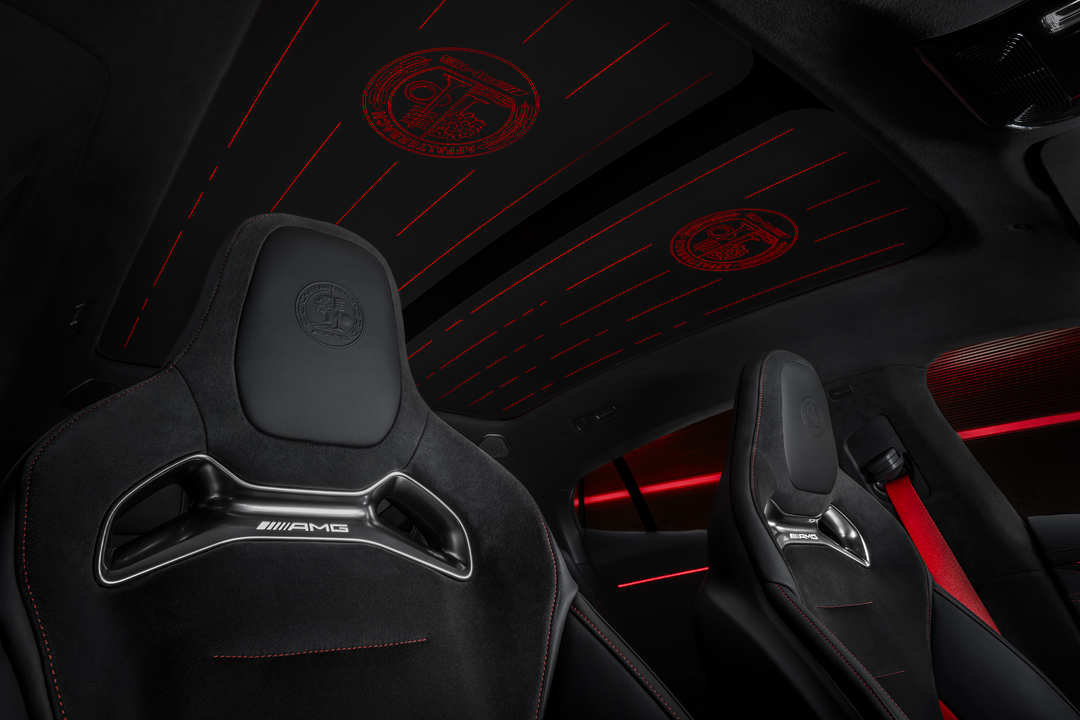
Inside, the panoramic glass roof can switch between transparent and opaque in individual segments. An optional light staging mode projects AMG crests and racing stripe patterns across the roof at night. The roof uses heat-insulating laminated safety glass with infrared-reflective and Low-Emissivity coatings. A carbon-fiber design ultralight roof is available in select markets.
The center console houses the three RACE ENGINEER rotary controllers, two inductive smartphone charging trays, illuminated cupholders, and a closed storage compartment. Front seats are newly developed with pronounced lateral support; optional AMG Performance seats with integrated head restraints are also available.
Series production begins in summer 2026 at the Mercedes-Benz Sindelfingen plant, which has operated since 1915. Assembly takes place in Hall 32, which has been upgraded specifically for AMG.EA production. Key body components, including press parts, body-in-white, and paintwork, are also produced on-site.
The axial flux motors, on the other hand, are manufactured at the Mercedes-Benz plant in Berlin-Marienfelde. Production involves around 100 processes, approximately 65 of which are new to Mercedes-Benz and 35 of which are described as world firsts. These include new laser joining techniques combined with AI-assisted processes. Mercedes-Benz developed most of these processes in-house and filed over 30 patent applications.




0 Comments
Leave a Reply